
The reality is that packaging systems are often more complex than they appear.
A packaging line succeeds or fails based on how equipment, controls, accumulation, utilities, and operators work together across the entire system. As a result, many packaging line problems originate not within individual machines but at the points where machines, controls, and processes converge.
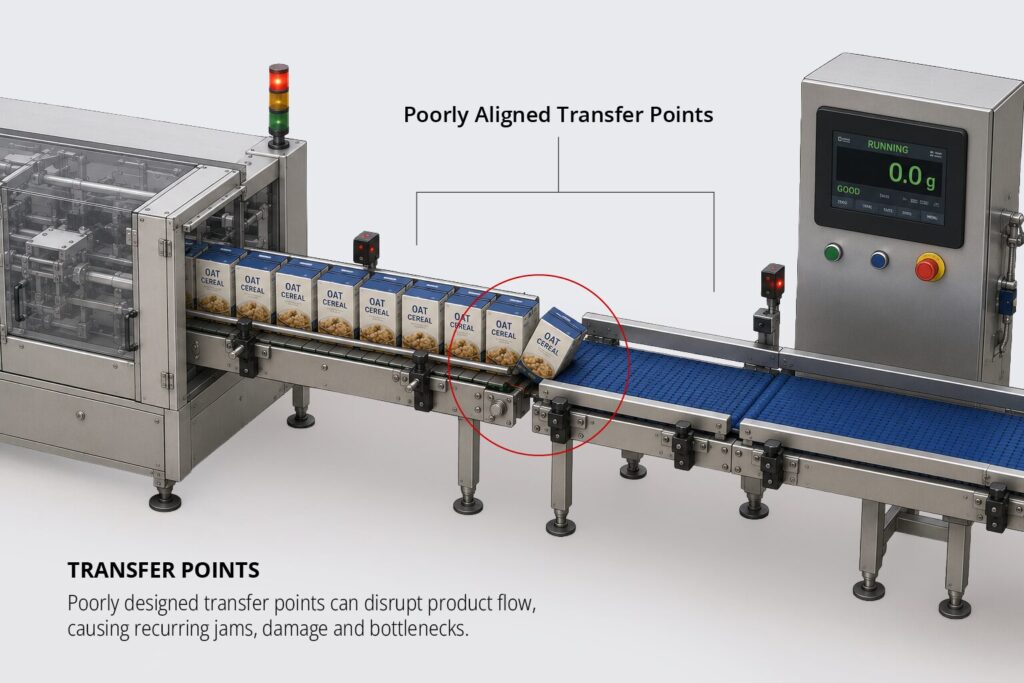
Equipment jams at transfer points. Controls don’t communicate as expected. Throughput assumptions don’t align. Responsibilities fall between suppliers.
A project that appears straightforward on paper can become significantly more complex once multiple machines, suppliers, and systems must work together. The effort to save money or maintain control can quickly evolve into a full-time exercise in vendor coordination, troubleshooting, and risk management.
The greatest integration challenges rarely originate within individual machines. Instead, these challenges emerge between machines, suppliers, responsibilities, and decisions made throughout the project lifecycle.
Machine Performance ≠ System Performance
A common assumption is that if each machine meets its performance specifications, the packaging line will meet its performance goals.
Machine performance does not guarantee system performance.
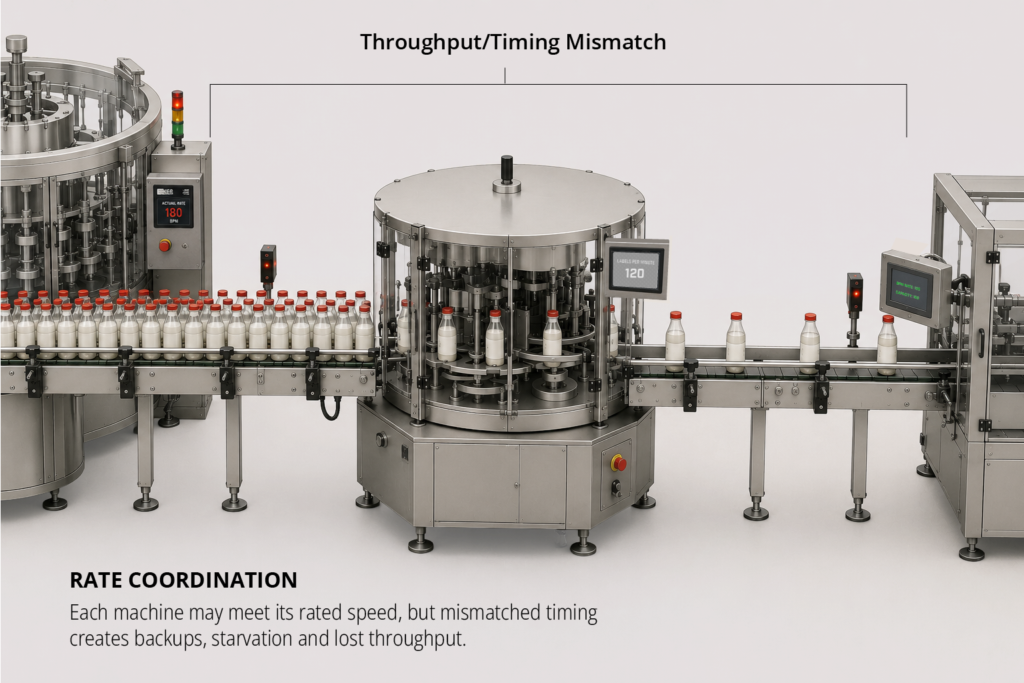
A cartoner may achieve its specified speed. A robot may hit its designed cycle rate. A palletizer may perform exactly as promised. Yet the packaging line can still struggle to achieve throughput targets because the system was never engineered to perform as a coordinated whole.
Packaging lines operate as interconnected systems. Product flow, accumulation, controls, machine interactions, and operator actions all influence overall performance, throughput, and uptime. A disruption at one point in the line can quickly affect equipment upstream and downstream.
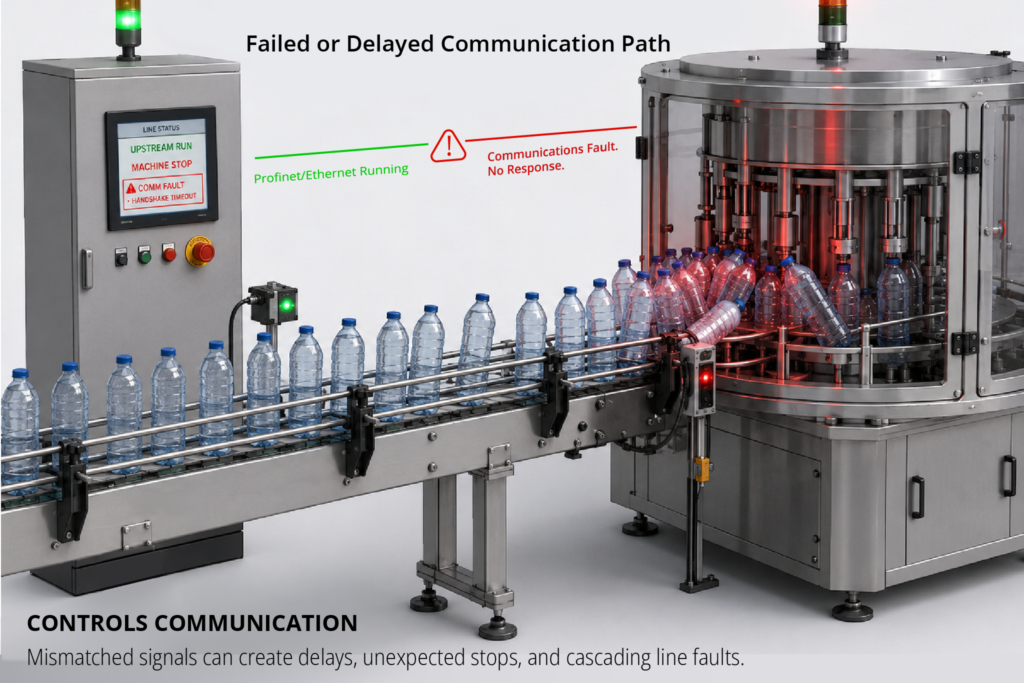
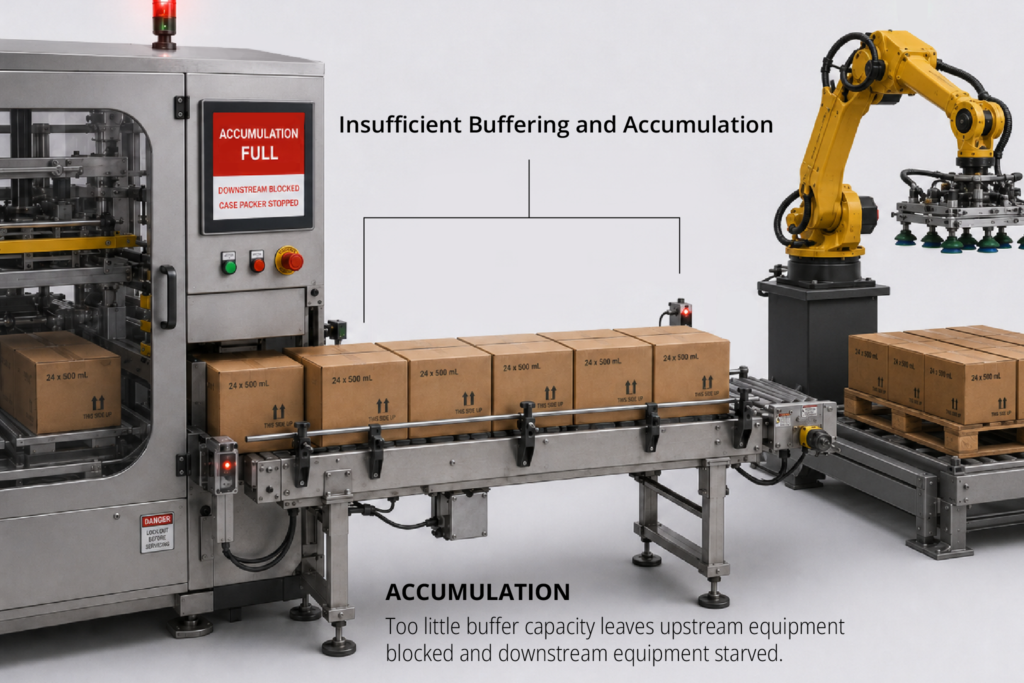
Bottlenecks often emerge where they are least expected. Transfer points become choke points. Equipment speeds don’t align. Controls communication creates unexpected delays. Accumulation capacity proves insufficient to absorb normal production variability.
Every machine may perform as specified, but the system still falls short of expectations.
No System Ownership
Most equipment suppliers are responsible for the performance of their machine. When multiple suppliers are involved, however, responsibility for the overall system can become fragmented. One vendor owns the cartoner. Another owns the robot. A third owns the palletizer. What appears to be a single project quickly becomes a collection of separate activities managed by different organizations.
Each supplier focuses on its portion of the project, but no one is responsible for ensuring the entire system functions as intended.
As the project progresses, responsibilities that once seemed clear become less defined. Who owns the communication between machines from different suppliers? Who coordinates startup activities? Who resolves issues when equipment doesn’t perform as expected? When responsibilities overlap or gaps emerge, who is accountable for finding a solution?
These gaps are rarely obvious at the beginning of a project. Responsibilities that seem clear during planning often become less defined when equipment, controls, and supporting systems must work together across multiple suppliers. By the time the gaps become visible, resolving them often requires additional time, resources, and cost.
When no one owns the system, ownership of the problems becomes the manufacturer’s responsibility.
Integration is a Discipline
Many food and beverage manufacturers have extensive experience purchasing equipment, managing capital projects, and coordinating suppliers. Because of this, packaging line integration is often viewed as a natural extension of those activities.
Integration requires expertise that extends beyond equipment selection and project coordination.
Successful integration requires far more than selecting equipment and overseeing installation. It requires anticipating problems before they impact startup, resolving conflicts before they cause delays, and making decisions based on the performance of the entire system rather than the needs of an individual machine.
This complexity is often underestimated because much of the work happens behind the scenes. Potential problems are identified before they impact startup, scope gaps are addressed before they create delays, and decisions are made with the performance of the entire line in mind.
Integration is not about connecting machines. It’s about making the system work.
Treating integration as a procurement or coordination exercise often underestimates the expertise required to achieve that outcome.
The Resource Drain
A common assumption behind managing packaging line integration internally is that it will reduce project costs. In some cases, it may reduce upfront expenses, but the work still needs to be performed.
When integration is managed internally, that work is often absorbed by engineers, maintenance leaders, project managers, and operations personnel who already have full-time responsibilities. Time spent coordinating suppliers, resolving issues, and managing project details is time that cannot be spent elsewhere.
Integration competes for the same time, bandwidth, and resources already committed elsewhere.
Because those costs are distributed across departments and responsibilities, they are not always reflected in project budgets. A project may appear less expensive on paper while consuming far more time and resources from internal teams than originally anticipated.
Every hour spent managing an integration is an hour not spent on other operational priorities.
The Cost of Delayed Startup
Equipment installation is only one step in the integration process. Before production can begin, equipment must be tested, validated, and proven to perform as a coordinated system.
When food and beverage manufacturers act as their own integrator, many integration challenges do not become apparent until equipment is installed, systems are tested, and startup activities begin. Controls require adjustment. Equipment interactions need refinement. Throughput assumptions must be validated. In some cases, additional modifications or equipment may be required before the system can achieve expected performance.
For existing production lines, these challenges can extend downtime and delay the return to production. For new installations, they can postpone startup schedules and delay the time required to bring new capacity online.
Delayed startup creates extended downtime, lost production time, and delays in bringing new capacity online.
The longer integration issues remain unresolved, the greater the impact on project timelines and business results.
The Bigger Question
Acting as your own integrator means taking responsibility for more than equipment selection and supplier coordination. It means assuming ownership of system performance, accountability, integration execution, and the resources required to support the project from planning through startup.
The challenge is recognizing these risks before they affect the project. Performance shortfalls, ownership gaps, underestimated integration demands, resource constraints, and startup delays often become visible only after installation begins, startup approaches, or performance expectations are tested under real-world conditions.
Recognizing the risks is only the beginning. Successfully managing them requires the experience to anticipate problems early, coordinate every element of the project, and engineer the packaging line to perform as a complete system.
IPM serves as your integration partner from planning through startup, bringing equipment, controls, suppliers, and execution together under one point of accountability.
One team.
One point of accountability.
One focus.
Your line performance.
Reduce integration risk with a partner focused on maximum uptime.