Higher machine speed can expose weaknesses that already existed inside the system.
Packaging lines depend on coordination. Fillers, conveyors, accumulation systems, transfer points, case packers, palletizers, and controls all influence one another under production conditions. A line running at 300 bottles per minute only performs effectively when every downstream process can absorb and sustain the same pace.
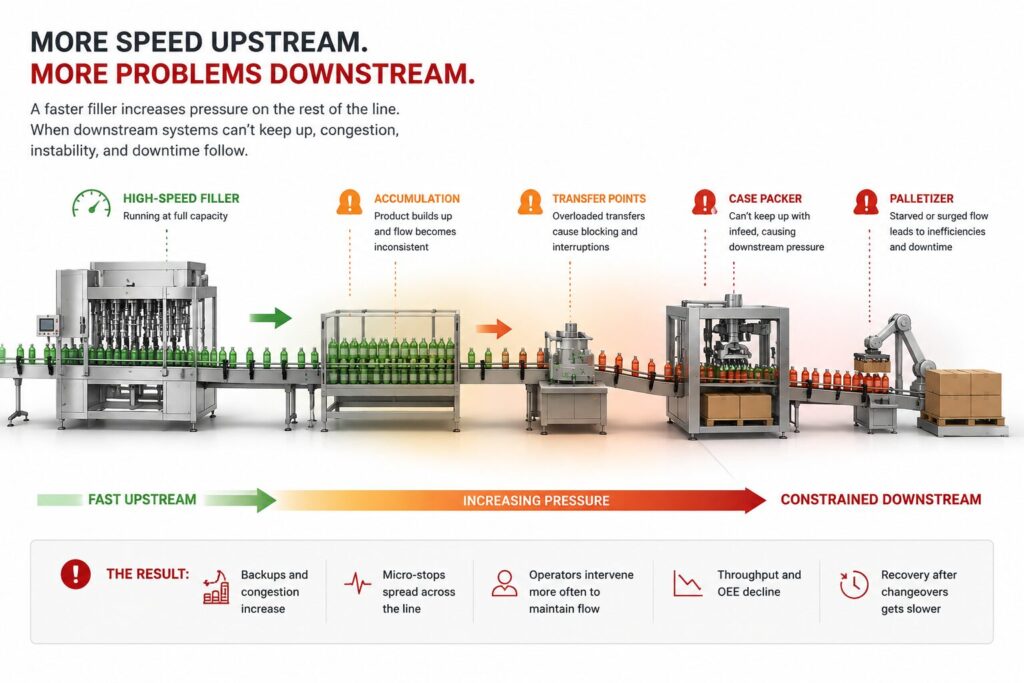
Signs a Packaging Line Is Out of Sync
Packaging lines rarely lose efficiency all at once. Most synchronization problems appear gradually as small disruptions begin affecting throughput, accumulation, and recovery behavior across the system.
A delayed transfer, overloaded accumulation zone, or downstream slowdown can quickly affect the rest of the packaging line. Production teams often see overall throughput decline even while some individual machines continue operating at target speed.
Packaging system performance is shaped by the interactions between in-line machine centers, not the isolated speed of individual equipment.
Machine-center upgrades often fail to deliver the expected throughput gains because packaging performance is determined at the system level, not the machine level.
Why Throughput Becomes Harder to Sustain at Scale
As throughput increases, packaging lines become less tolerant of timing variations, recovery delays, and inconsistent product flow between machine centers.
Small disruptions rarely stay isolated in complex packaging environments. Some machine centers recover quickly while others require longer stabilization periods. Those mismatches disrupt flow across upstream and downstream operations.
Many packaging lines can briefly achieve targeted throughput. Sustaining steady-state performance across an entire shift is far more difficult.
High-performing packaging lines are engineered for sustained runnability, not isolated speed.
The V-Curve Principle for Packaging Line Balance
IPM applies the V-Curve Principle to identify the operational constraint governing line performance and synchronize surrounding machine centers to support stable, continuous flow.
The fastest machine on the line does not determine system OEE.
Every packaging line contains a point of constraint that ultimately determines sustainable throughput. In many operations, the limiting factor is not a single breakdown event, but recurring instability within the system.
- A machine center with lower sustained throughput
- Recurring micro-stops that disrupt recovery
- Accumulation pressure between machine centers
- Transfer points sensitive to flow variation under load
- Downstream systems unable to maintain consistent pace
Once the constraint is identified, upstream and downstream systems are engineered to maintain controlled flow around that point. Conveyance, controls, accumulation, and machine sequencing are aligned to reduce instability and improve runnability across the entire line.
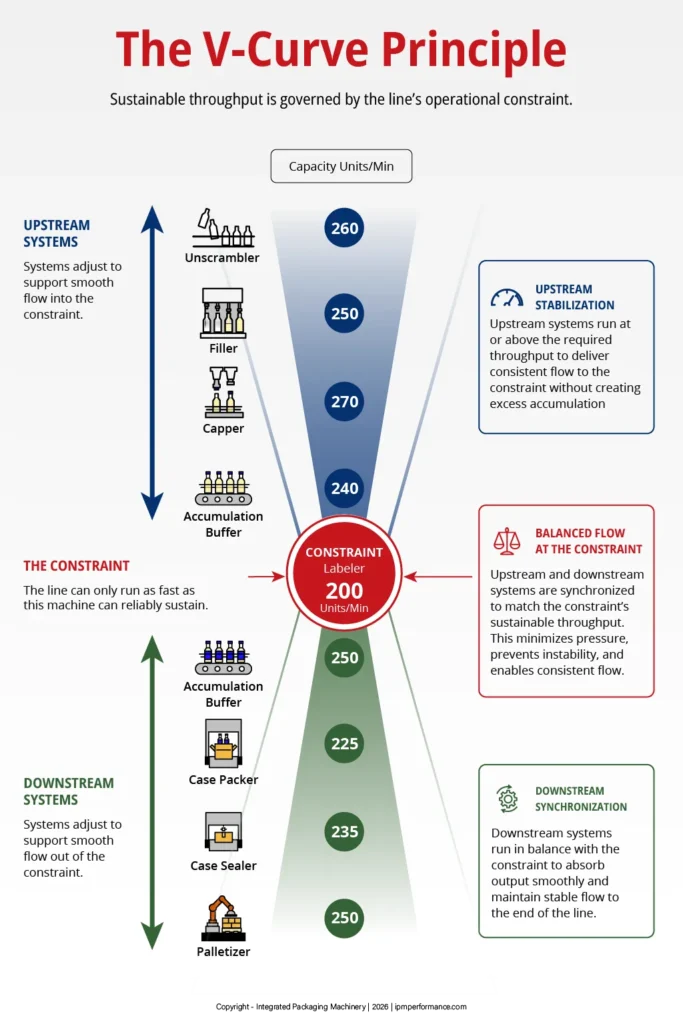
The V-Curve approach reduces operational variability and improves recovery consistency after interruptions. Rather than maximizing isolated machine speed, the system is engineered to sustain coordinated performance under real production conditions.
Packaging lines designed around coordinated flow typically achieve more predictable uptime, stronger OEE performance, and more sustainable long-term throughput.
Engineering Packaging Lines as One Integrated System
Packaging performance is determined by system coordination, not isolated machine speed.
System-as-a-Machine is the philosophy behind that approach. Every machine center is engineered to operate as part of a coordinated system rather than an isolated point of performance.
The focus is not on isolated machine speed. The focus is sustained operational performance across the full line. Conveyance, controls, accumulation, robotics, and downstream packaging systems are aligned to maintain stable flow, protect product quality, and support long-term runnability under real operating conditions.
By treating the packaging line as a unified system, IPM helps manufacturers reduce downtime, improve changeover efficiency, and accelerate time-to-value across complex production environments.
Sustainable Throughput Starts with System Coordination
IPM engineers packaging lines for coordinated performance, reliable uptime, and long-term operational efficiency.