
Project Overview
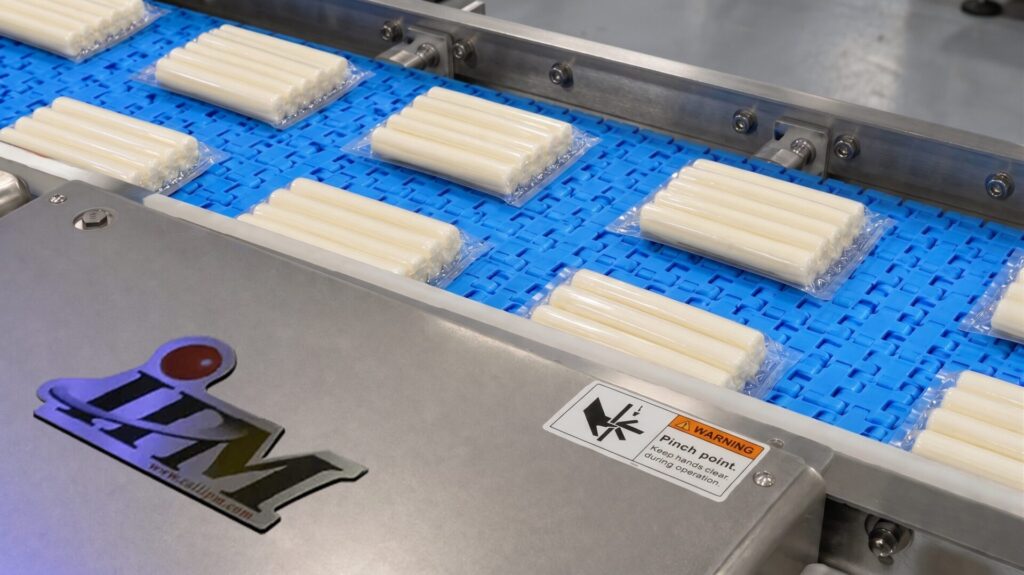
A global dairy producer needed to expand string cheese packaging capacity to support growing demand while maintaining the flexibility required to accommodate a large and complex SKU mix. The project involved two new fully automated secondary packaging lines serving major retail channels.
The high-speed packaging lines needed to support production rates of up to 1,440 string cheese sticks per minute while accommodating multiple package counts, case formats, and pallet configurations.
The operation required a secondary packaging system capable of supporting frequent product changeovers, maintaining production efficiency, and adapting to evolving facility requirements while preserving throughput and future growth potential.
The Problem
High SKU Complexity and Packaging Variability
The customer’s string cheese portfolio included a wide range of package counts, case styles, display-ready formats, and pallet configurations. The secondary packaging system needed to accommodate:
- Multiple package counts
- Display-ready and standard case formats
- Retailer-specific packaging requirements
- Various pallet configurations and patterns
- Label orientation requirements for distribution and merchandising
Supporting this level of complexity required a system capable of adapting quickly to changing production requirements without creating excessive changeover time or operational inefficiencies.
Balancing Flexibility with High-Speed Throughput
The new packaging lines needed to support production rates of up to 1,440 string cheese sticks per minute while accommodating frequent product changeovers and diverse package formats.
The challenge wasn’t achieving flexibility or efficiency. It was achieving both.
Supporting a large SKU mix typically introduces additional changeovers, equipment requirements, and operational complexity. The system needed to accommodate frequent product transitions while maintaining the high production rates required to meet demand.
Achieving both objectives required careful system design. The solution needed to minimize downtime, preserve valuable floor space, and support a broad range of product configurations without compromising overall line performance.
Floor Space and Layout Constraints
The new packaging lines needed to fit within available floor space while supporting throughput, flexibility, and future growth objectives.
As facility plans evolved during the project, the system design required ongoing coordination to accommodate layout changes without impacting throughput, schedule, or overall project objectives. The final solution needed to maintain operational efficiency while providing flexibility for future expansion.
IPM’s Solution
Engineering Flexibility Without Sacrificing Efficiency
IPM engineered the secondary packaging system around the customer’s need for flexibility without sacrificing operational efficiency.
Automated and quick-changeover functionality was incorporated throughout the system to support rapid transitions between package formats. Equipment selection and line architecture were designed to accommodate multiple package counts, case styles, display-ready formats, and pallet configurations while minimizing operator intervention.
To further improve efficiency, bypass paths were incorporated where appropriate. Products that did not require specific packaging operations could move through the system without additional equipment or unnecessary conveyor infrastructure, preserving valuable floor space while maintaining flexibility.
Integrated Packaging Operations and Line Control
IPM was responsible for the complete secondary packaging integration strategy, including:
- Conveyance and accumulation
- Case handling
- Case bottom sealing
- Case labeling and coding
- Lid application and taping
- Palletizing
- Stretch wrapping
- System-wide controls and line integration
IPM approached the project as a system integration challenge rather than a collection of standalone machines.
Integration is a service, not a piece of equipment.
The integration team worked across multiple OEMs to verify communication compatibility, controls integration, product transfers, and operational sequencing throughout the line, helping ensure all machine centers operated as a coordinated system.
Conveyance and accumulation systems played a critical role in overall line performance. Machine-stop protocols, restart sequences, and accumulation strategies were incorporated to support efficient recovery from interruptions, maintain product flow, and minimize the need for operator intervention.
These elements were engineered to operate as a unified system rather than a collection of individual machines, helping the customer maintain flexibility, throughput, and operational efficiency across a wide range of product configurations.
Single-Source Project Execution
Beyond system design and integration, IPM provided installation, startup, commissioning, operator training, and coordination across multiple OEMs and project stakeholders.
This turnkey approach gave the customer a single point of accountability throughout the project, helping ensure OEMs, controls systems, and installation activities remained aligned from design through commissioning.
The Outcome
At the time this case study was prepared, the project was in startup and commissioning.
The new secondary packaging lines expand the customer’s capacity while providing the flexibility needed to support a large and complex string cheese product portfolio. Automated changeover capabilities, integrated line control, and a coordinated system architecture allow the operation to accommodate multiple package formats, case styles, and pallet configurations without sacrificing efficiency.
By approaching the project as a complete packaging system rather than a collection of individual machines, IPM delivered a solution capable of balancing two objectives that often compete with one another: flexibility and efficiency. The result is a high-speed packaging system engineered to accommodate a diverse SKU portfolio, sustained throughput, and long-term growth.
Explore IPM’s Cheese Packaging Solutions
Cheese packaging lines present unique challenges related to product variability, sanitation requirements, accumulation constraints, and downstream line performance. Learn how IPM engineers integrated packaging systems that maintain stable flow, sustained throughput, and operational efficiency across a wide range of cheese products and packaging formats.